






































































































































































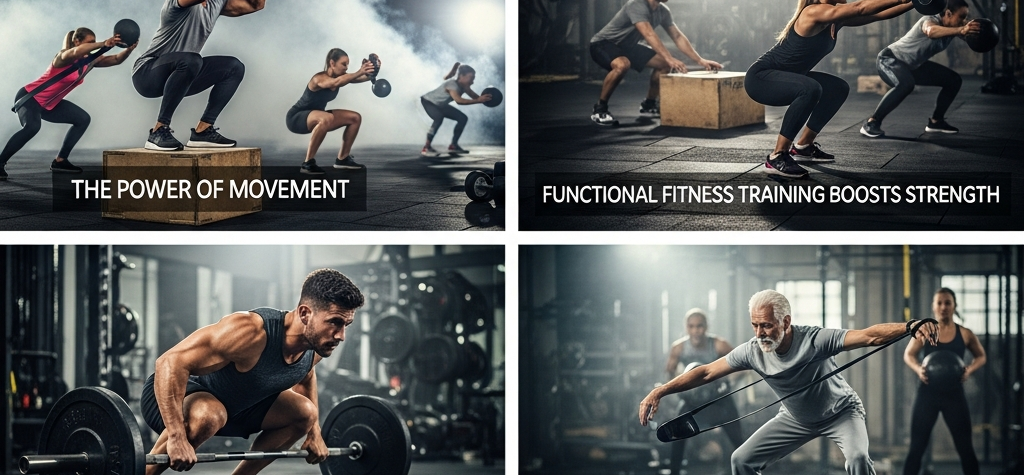
Functional Fitness Training: Exercises for Strength, Mobility and Healthy Aging
Author: RVLNSV PRASAD
Updated On: October 2026
About Us
Author Bio
Editorial Policy
Contact Us
Introduction
Functional fitness training is not about making every workout harder. It is about making everyday movement easier, stronger, and more controlled.
Think about ordinary tasks. Getting out of a chair requires leg strength. Carrying groceries requires grip and upper-body strength. Climbing stairs requires strength, balance, and cardiovascular capacity. Picking something up from the floor requires coordination between the hips, legs, and trunk.
These movements rarely happen one muscle at a time.
That is why functional fitness can be useful. It connects exercise with the physical tasks people actually perform during work, family life, travel, and aging.
The idea also fits modern exercise guidance. The World Health Organization recommends that adults combine aerobic activity with muscle-strengthening work, while older adults should also emphasize balance and functional strength as part of their weekly activity. WHO physical activity recommendations
Recent research makes the topic even more interesting. A 2026 systematic review and meta-analysis of multicomponent training in older adults found improvements in several measures of functional fitness. Another 2026 systematic review of functional task training reported improvements in balance, mobility, and walking performance in adults aged 60 and older. 2026 systematic review of multicomponent training 2026 systematic review of functional task training
The important point is that functional fitness is not a special category reserved for athletes.
It is designed to be practical for different lifestyles, so both beginners and busy parents can use it.
Someone exercising at home can use it.
And an older adult can adapt it to support strength, balance, and independence.
Quick Answer: What Is Functional Fitness Training?
Functional fitness training uses exercises that develop strength, coordination, balance, mobility, and endurance for movements that resemble or support everyday activities.
Common patterns include:
- Squatting
- Hinging
- Pushing
- Pulling
- Carrying
- Stepping
- Rotating
- Getting up and down
- Maintaining balance while moving
Functional training does not mean every exercise must perfectly copy a daily task. A conventional squat, row, or resistance-band exercise can still improve physical abilities that transfer to everyday life.
The goal is simple: build physical capacity that you can use outside the workout.
Key Takeaways
- Functional fitness connects exercise with useful movement abilities.
- Strength, balance, mobility, and aerobic fitness all matter for healthy aging.
- Functional training does not have to be extreme or complicated.
- Beginners can start with bodyweight exercises and gradually add resistance.
- Older adults can benefit from strength and balance exercises adapted to their abilities.
- Functional fitness can be performed at home with little or no equipment.
- Recent research supports functional and multicomponent training for improving physical performance in older adults. 2026 research on multicomponent training and functional fitness
- Consistency is more important than constantly changing exercises.
- Functional training should complement, not necessarily replace, aerobic exercise.
- People with significant medical conditions, pain, dizziness, recent surgery, or balance problems may need individualized professional guidance.
What Makes Functional Fitness Different?
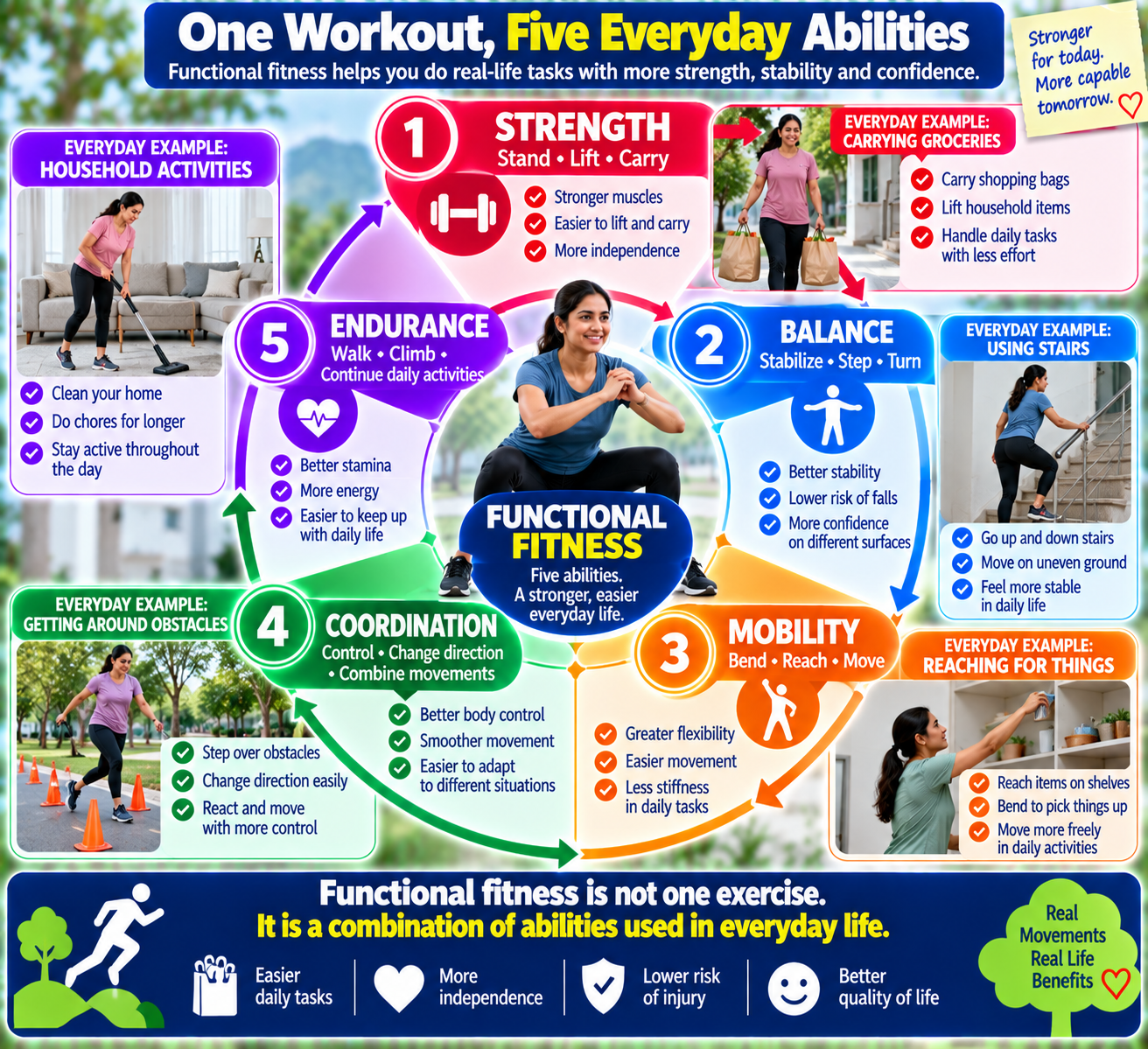
Functional fitness is best understood as a training approach rather than one specific exercise system.
- A squat can be functional.
- A resistance-band row can be functional.
- A farmer’s carry can be functional.
- A step-up can be functional.
Even getting up from a chair can become a useful strengthening exercise when performed appropriately.
The difference is often the purpose behind the movement.
Instead of asking only, “Which muscle am I training?” functional training also asks:
“What physical ability am I trying to improve?”
For example:
| Everyday challenge | Physical ability | Useful exercise |
|---|---|---|
| Getting out of a chair | Leg strength | Chair squat |
| Carrying groceries | Grip and whole-body strength | Farmers carry |
| Climbing stairs | Leg strength and endurance | Step-ups |
| Reaching overhead | Shoulder mobility and strength | Overhead press |
| Picking up an object | Hip and trunk control | Hip hinge |
| Getting up from the floor | Strength, mobility, and coordination | Supported floor transition |
| Maintaining stability | Balance | Supported single-leg stance |
This approach makes exercise easier to connect with real life.
The 6 Fundamental Movement Patterns
You do not need dozens of exercises to build a useful functional fitness routine.
A small collection of movement patterns can cover a large part of everyday physical ability.
1. Squat
Squatting involves bending the knees and hips while controlling the body’s descent and rise.
You use similar abilities when:
- Sitting down
- Standing up
- Picking something from a low surface
- Using a low seat
- Moving around the home
A beginner can start with a chair squat.
Stand in front of a sturdy chair. Move your hips backward and lower yourself under control. Touch the chair lightly, then stand again.
The chair provides a useful reference point and can make the movement less intimidating.
2. Hip Hinge
The hip hinge teaches you to move primarily from the hips while keeping the trunk controlled.
This pattern is important when lifting objects from the floor.
A simple beginner drill is to stand with your back a short distance from a wall. Push your hips backward until they gently contact the wall, then return to standing.
This can help people understand the difference between bending from the hips and simply rounding the back.
3. Push
Pushing strength is useful for everyday tasks such as opening heavy doors or moving objects.
A wall push-up is an accessible starting point.
As strength improves, you can progress to a higher-angle push-up, countertop push-up, knee-supported variation, or floor push-up, depending on your ability.
4. Pull
Pulling exercises train muscles of the back and upper body.
A resistance-band row is a practical home option.
The exercise can also help balance a routine that contains many pushing movements.
5. Carry
Carrying is one of the most practical functional exercises because people carry objects throughout everyday life.
A farmer carry can be performed with:
- Dumbbells
- Kettlebells
- Resistance implements
- Appropriately loaded household objects
The important principle is controlled walking while maintaining good posture and grip.
Do not turn carrying into a competition with yourself.
6. Step and Balance
Stepping onto a low, stable platform resembles many daily activities.
Step-ups can train leg strength, coordination, and balance.
For beginners or older adults, the priority should be stability rather than height.
Balance exercises can be especially important with increasing age. The National Institute on Aging recommends combining aerobic, muscle-strengthening, and balance activities for older adults. National Institute on Aging: Three Types of Exercise
Functional Fitness and Healthy Aging
Healthy aging is not simply about living longer.
It is also about maintaining the ability to perform meaningful activities.
- Can you walk comfortably?
- Can you stand from a chair?
- Can you carry your shopping?
- Can you climb stairs?
- Can you get dressed without excessive difficulty?
- Can you maintain your balance while moving?
These abilities influence independence.
The National Institute on Aging notes that strength training can help maintain muscle mass, improve mobility, and support independence as people age. National Institute on Aging: Strength Training and Healthy Aging
This is one reason functional fitness for older adults should not focus only on appearance.
A stronger body can have a practical value that becomes increasingly obvious with age.
What Does the Latest Research Say?
The research picture has become more useful because recent studies are looking beyond muscle size alone.
A 2026 systematic review and meta-analysis examined multicomponent training in older adults and found improvements across several functional-fitness measures. The researchers evaluated 20 studies involving older adults and reported benefits across outcomes such as strength, balance, mobility, and other measures of physical function. 2026 systematic review and meta-analysis of multicomponent training
Another 2026 systematic review and meta-analysis looked specifically at functional task training in adults aged 60 and older. Twelve trials involving 491 participants were included. Compared with control interventions, functional task training produced significant improvements in balance, timed mobility, and six-minute walking performance. 2026 functional task training meta-analysis
That distinction matters.
Resistance training research also continues to support progressive strength work. A 2025 systematic review and network meta-analysis covering 151 randomized trials examined different resistance-training volumes in older adults and evaluated outcomes including physical function, lean mass, strength, and lower-body muscle development. Resistance-training volume systematic review and network meta-analysis
A Major 2026 Development: Resistance Training Does Not Need to Be Complicated
One of the most useful recent developments comes from the American College of Sports Medicine’s 2026 position stand on resistance training.
The position stand emphasizes consistency, individualization, and gradual progression. It also notes that effective resistance training does not require expensive equipment or complicated methods for the average healthy adult. Bodyweight exercises, elastic bands, and home-based training can be useful options. ACSM 2026 resistance-training position stand summary
This is particularly relevant to functional fitness.
You do not need a sophisticated gym to get started; instead, choose an exercise that matches your current ability and gradually make it more challenging as your fitness improves.
Why Strength Matters for Everyday Life
Strength is not only about lifting heavy weights.
It can influence how easily you perform ordinary tasks.
Imagine two people carrying grocery bags.
- The first person struggles after a short distance.
- The second person carries the same bags comfortably.
- The difference may involve strength, conditioning, grip, balance, movement efficiency, and familiarity with the task.
Strength training can help make daily activities easier. Mayo Clinic notes that strength training can improve muscle strength and make everyday activities easier, while balance exercises can help reduce fall risk. Mayo Clinic: Exercise and chronic disease
Functional strength training therefore has a practical objective:
Build enough physical capacity that normal life does not feel unnecessarily difficult.
Functional Fitness and Balance
Balance is sometimes ignored until a person notices that it has become harder.
That is a mistake.
Balance is a trainable physical ability, although the appropriate exercises depend on the person.
Simple examples include:
- Supported single-leg standing
- Heel-to-toe walking
- Controlled step-ups
- Sit-to-stand exercises
- Tai chi
- Carefully performed balance drills
The National Institute on Aging recommends balance exercises for older adults and provides examples such as standing on one foot, heel-to-toe walking, and controlled sit-to-stand movements. NIA balance and exercise guidance
A 2020 overview of systematic reviews also found evidence that balance and functional training can reduce falls and improve physical-function outcomes in adults aged 65 and older, although the researchers noted uncertainty around some outcomes and variation in evidence quality. Systematic review of balance and functional training
A People-First Functional Fitness Strategy
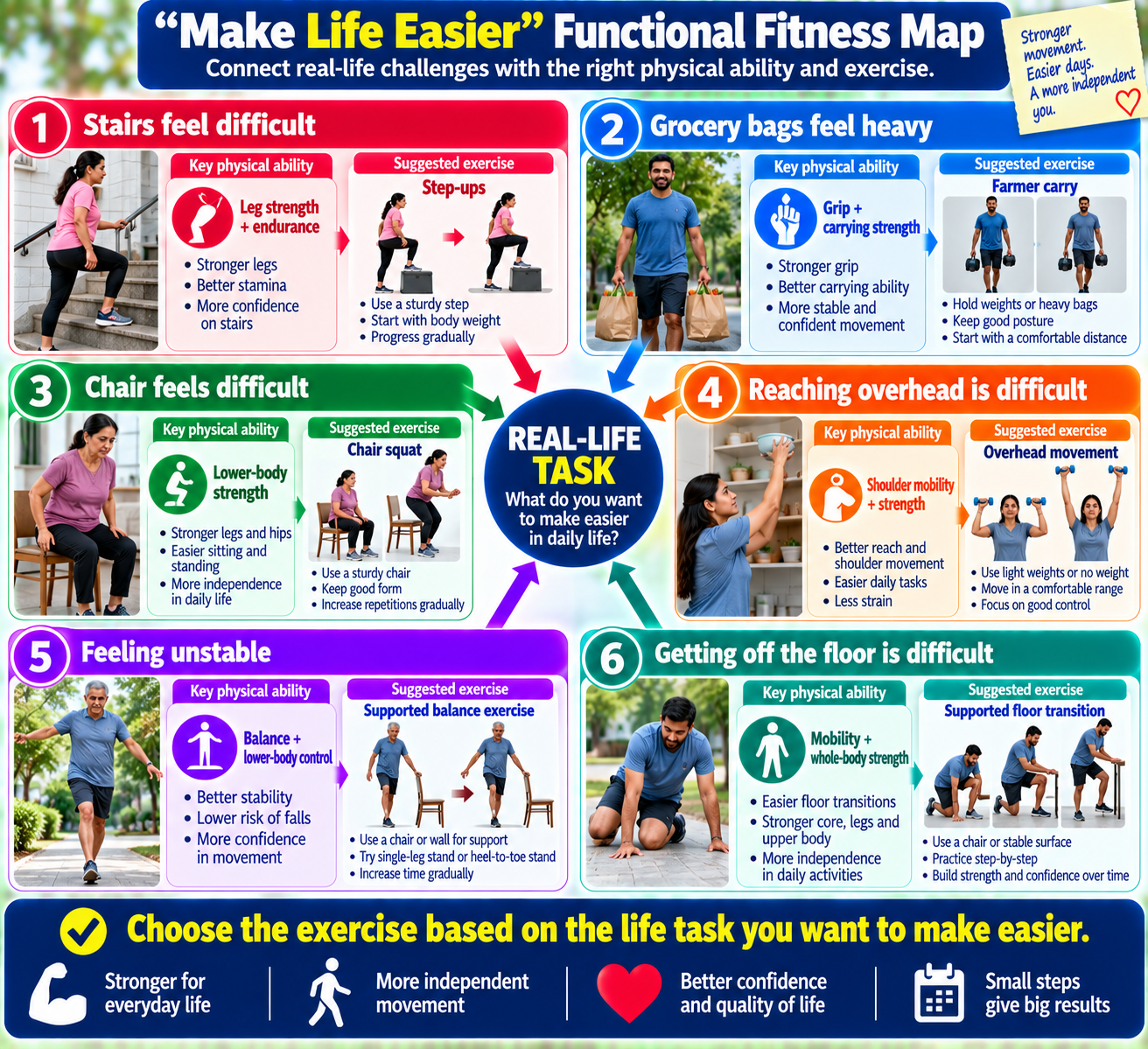
Here is a simple approach that I believe is more useful than telling everyone to follow the same workout.
Start with the task that matters to you.
- If stairs are difficult, train stepping and leg strength.
- If carrying groceries is difficult, train carrying and grip.
- If getting out of a chair is difficult, work on controlled sit-to-stands.
- If balance feels uncertain, begin with supported balance exercises.
- If getting down to the floor is difficult, work on mobility and controlled transitions with appropriate support.
This turns exercise from an abstract fitness goal into a practical problem-solving tool.
The “Make Life Easier” Test
Before choosing an exercise, ask:
What do I want to make easier?
Then connect that task with a physical ability.
| Problem | First ability to develop |
|---|---|
| Stairs feel difficult. | Leg strength + endurance |
| Grocery bags feel heavy. | Carrying strength |
| Standing from a chair is difficult. | Leg strength |
| Reaching overhead feels restricted. | Shoulder mobility + strength |
| Feeling unstable while walking | Balance + lower-body strength |
| Getting up from the floor is difficult. | Mobility + whole-body strength |
| Getting tired during household tasks | Aerobic capacity + strength |
This is a simple people-first framework because it starts with the person’s life rather than the exercise equipment.
Functional Fitness for Beginners
Beginners do not need to start with advanced circuits.
A basic routine could include:
- Chair squats
- Wall push-ups
- Resistance-band rows
- Supported step-ups
- Hip-hinge practice
- Light carries
- Gentle mobility work
Start with a level that allows controlled technique.
The goal is not to finish exhausted; instead, you should finish knowing that you could perform the movement again with reasonable control.
A Simple 20-Minute Functional Fitness Routine
This routine is an example for a generally healthy beginner. It is not a personalized medical prescription.
Warm-up: 4 minutes
Walk around the room.
Move the shoulders gently.
Perform several slow sit-to-stands.
Practice easy hip hinges.
Strength circuit: 10 minutes
Perform the following exercises at a comfortable level:
Chair squat: 8–12 repetitions
Wall push-up: 8–12 repetitions
Resistance-band row: 8–12 repetitions
Supported step-up: 6–10 repetitions per side
Light carry: 20–30 seconds
Rest as needed.
Balance and mobility: 4 minutes
Perform supported single-leg standing.
Follow it with gentle ankle, hip, and shoulder mobility.
Cool-down: 2 minutes
Walk slowly and allow breathing to return toward normal.
The routine can be modified considerably. The important principle is to match the difficulty to your current ability.
The “Minimum Useful Workout” for Busy Days
One of the easiest ways to improve consistency is to stop treating every workout as an all-or-nothing event.
On a busy day, your minimum session could be
- 5 chair squats
- 5 wall push-ups
- 5 rows
- 30 seconds of walking
- 20 seconds of supported balance
That is not a complete fitness program.
It is a consistency tool.
The 2026 ACSM resistance-training guidance emphasizes that doing some resistance training consistently is more useful than creating an unnecessarily complicated plan that you cannot maintain. ACSM 2026 resistance-training guidance
Functional Fitness at Home
A gym can be useful, but it is not mandatory.
Home-based options include:
- Bodyweight squats
- Wall push-ups
- Step-ups
- Resistance bands
- Dumbbells
- Water bottles
- Backpacks
- Walking
- Carrying appropriate household objects
NIA also notes that many strengthening activities can be performed with body weight or everyday objects, including carrying groceries and gardening. NIA exercise and physical activity guidance
The important consideration is safety.
A household object should be stable and easy to grip. Do not improvise with something that could break, spill, shift unexpectedly, or cause injury.
Functional Fitness for Older Adults
Functional fitness for older adults should emphasize ability rather than intensity.
A suitable program may combine:
- Walking
- Strength training
- Balance exercises
- Mobility work
- Sit-to-stand practice
- Step training
- Carrying
- Appropriate aerobic activity
The CDC recommends that adults 65 and older include aerobic activity, muscle-strengthening activity on at least two days each week, and balance activities. CDC older-adult physical activity recommendations
WHO similarly recommends at least 150 minutes of moderate aerobic activity weekly for adults and muscle-strengthening activities on two or more days. Older adults with poor mobility should also include activities that improve balance and help prevent falls on three or more days per week. WHO physical activity recommendations
The exact program should still be adapted to the person’s health, mobility, and experience.
Functional Fitness Does Not Replace Cardio
This is an important distinction.
A person can become stronger without developing enough aerobic fitness; therefore, a complete physical-activity routine can combine:
Aerobic fitness + strength + balance + mobility
Walking, cycling, swimming, and other aerobic activities can complement functional strength training.
WHO recommends 150–300 minutes of moderate-intensity aerobic activity per week for adults, or the equivalent amount of vigorous activity, together with muscle-strengthening activity on at least two days. WHO physical activity guidelines
For older adults, adding balance and functional activities becomes particularly important.
Nutrition for Functional Strength
Exercise is only one part of physical function.
Food provides energy and nutrients required to support training and recovery.
A balanced eating pattern can include:
- Protein-rich foods
- Vegetables
- Fruits
- Whole grains
- Legumes
- Nuts and seeds
- Healthy fats
- Adequate fluids
Protein is particularly relevant when the goal is maintaining or developing muscle.
However, more protein is not automatically better for everyone. Individual needs can differ according to age, body size, activity, dietary pattern, and health conditions.
If you have kidney disease or another condition requiring dietary restrictions, discuss protein intake with your healthcare professional rather than copying a generic fitness diet.
Recovery Is Part of Training
A common mistake is treating rest as wasted time.
Training provides a stimulus.
Recovery allows the body to respond to that stimulus.
Recovery can include:
- Adequate sleep
- Rest between demanding sessions
- Appropriate food intake
- Hydration
- Managing training volume
- Gentle movement on easier days
You do not need to feel sore after every workout for exercise to be effective.
Soreness is not a reliable score of workout quality.
How to Progress Functional Fitness Safely
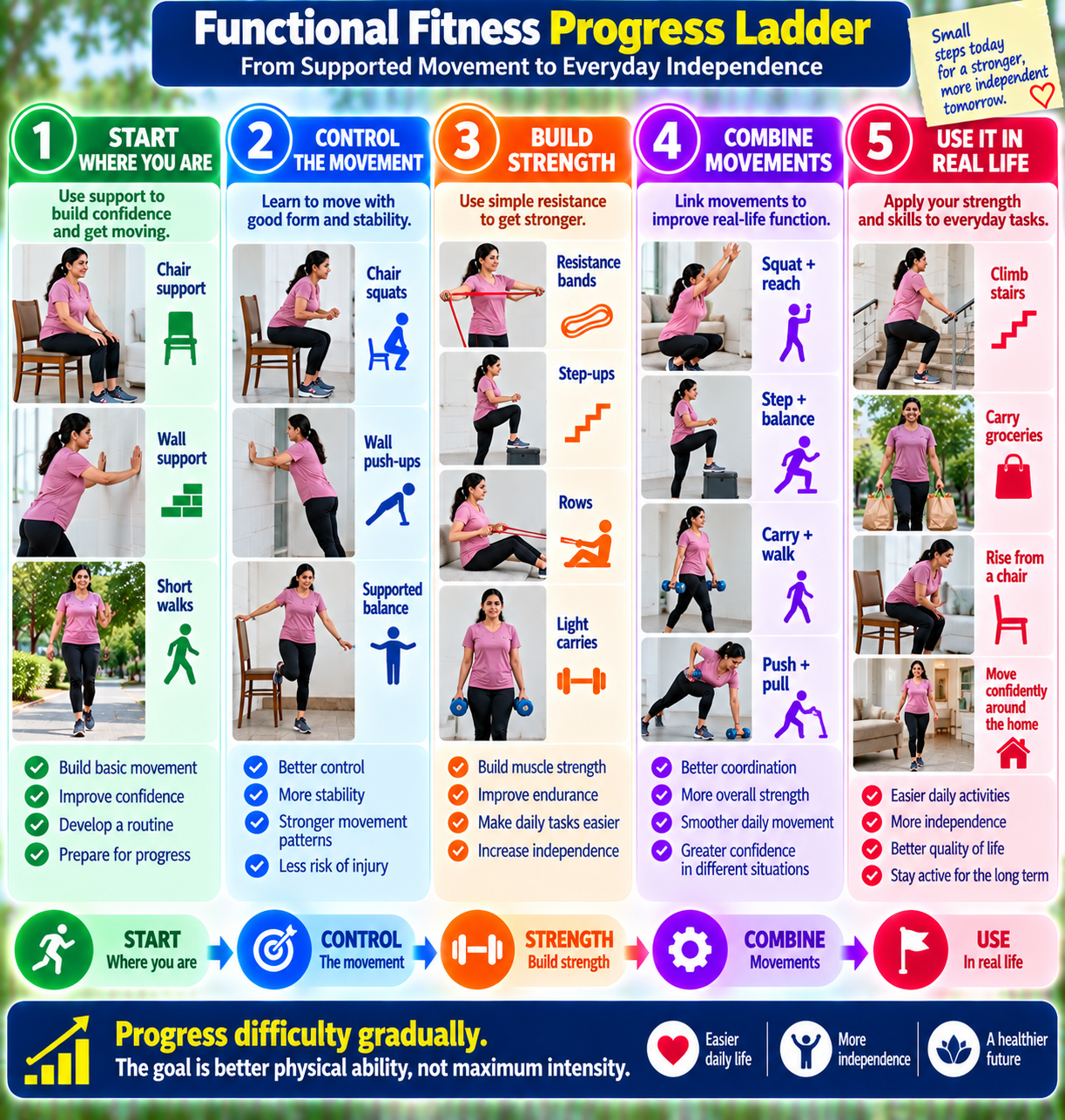
Progress does not always mean adding heavier weights.
You can progress by:
- Adding a few repetitions
- Increasing resistance
- Increasing range of motion when appropriate
- Improving control
- Adding another set
- Increasing walking duration
- Improving balance
- Reducing unnecessary rest
- Using a more challenging variation
Only change one or two variables at a time.
For example, if chair squats have become easy, you might first increase repetitions. Later, you could progress to a lower chair or an appropriately loaded squat.
The 2026 ACSM position stand supports gradual progression and emphasizes matching resistance-training choices to the person’s goals and circumstances. ACSM 2026 position stand
Common Functional Fitness Mistakes
Mistake 1: Trying to make every exercise extreme
Functionality does not mean exhausting.
Quality movement matters.
Mistake 2: Copying an advanced workout
An exercise that looks impressive online may be inappropriate for a beginner.
Start with your current ability.
Mistake 3: Ignoring balance
Strength alone does not address every aspect of physical function.
Older adults especially benefit from including balance work. CDC older-adult activity guidance
Mistake 4: Increasing weight too quickly
Rapid progression can make technique deteriorate.
Increase difficulty gradually.
Mistake 5: Training only what you enjoy
Walking is excellent.
Strength training is also important.
Likewise, balance and mobility have their own roles.
Mistake 6: Treating pain as something to push through
Exercise can be challenging without being painful.
Persistent, severe, or unusual pain deserves assessment rather than repeated attempts to “train through it.”
Mistake 7: Changing programs every week
Constant novelty makes progress difficult to evaluate.
Stay with a reasonable routine long enough to learn whether it works.
A Simple Functional Fitness Progress Tracker
Instead of tracking only body weight, consider recording functional changes.
| Measure | Starting point | Later check |
|---|---|---|
| Chair squats | How many controlled repetitions? | Has control improved? |
| Step-ups | How stable are they? | Is movement easier? |
| Carrying | How long can you carry safely? | Has capacity improved? |
| Walking | Comfortable duration | Has duration increased? |
| Balance | Supported or unsupported | Is stability better? |
| Push-ups | Wall/counter/floor | Has variation progressed? |
| Daily tasks | What feels difficult? | What feels easier now? |
This approach gives you feedback that is meaningful beyond appearance.
A Personal Experience Perspective
I prefer to look at fitness through the question, “What will this help a person do in real life?”
A workout can look impressive on paper and still be a poor choice for someone who cannot perform its movements safely.
Conversely, a simple chair squat can be extremely meaningful for someone who wants to stand from a chair more easily.
That is why functional fitness should not become another performance competition.
- For one person, progress may mean carrying groceries without stopping.
- For another, it may mean climbing stairs with greater confidence.
- For an older adult, maintaining the ability to rise from a chair independently can matter far more than achieving a particular gym milestone.
This people-first perspective is one of the strongest reasons to make functional ability part of a fitness plan.
A Practical “Everyday Strength” Challenge
Try identifying one daily movement that you want to make easier.
Then choose one exercise that supports it.
For example:
- Goal: Make stairs easier
Exercise: Step-ups - Goal: Carry groceries more comfortably
Exercise: Farmer carries - Goal: Stand from a chair more easily.
Exercise: Chair squats - Goal: Improve confidence while standing
Exercise: Supported balance practice - Goal: Make reaching overhead easier
Exercise: Appropriate shoulder mobility and strengthening
Do this consistently instead of trying to overhaul your entire lifestyle overnight.
What Functional Fitness Cannot Do
Functional fitness is valuable, but it is not a cure for every health problem.
It cannot guarantee:
- A longer lifespan
- No injuries
- No falls
- No chronic disease
- Permanent joint pain relief
- Complete protection against age-related muscle loss
Exercise also cannot replace medical treatment when treatment is needed.
The more accurate message is that regular physical activity can support physical function and contribute to healthier aging.
NIA describes physical activity as an important part of healthy aging and notes that regular activity can provide both immediate and long-term health benefits. National Institute on Aging: Health Benefits of Exercise and Physical Activity
When You Should Get Professional Guidance
Speak with a qualified healthcare professional or exercise professional if you have:
- Chest pain during activity
- Unexplained dizziness
- Fainting
- Significant shortness of breath
- A recent operation
- A recent serious injury
- Significant balance problems
- Severe or persistent joint pain
- A condition that limits exercise
- Major uncertainty about which exercises are safe
People with balance problems may require individualized exercises. NIA notes that some balance disorders need assessment and patient-specific exercises developed by an appropriate professional. NIA: Older Adults and Balance Problems
Medical Disclaimer
This article is for general educational purposes and does not provide individual medical advice, diagnosis or treatment. Exercise recommendations should be adapted to your age, health status, physical ability and previous injuries. If you have a medical condition, significant symptoms or concerns about starting exercise, speak with an appropriate healthcare professional before beginning or substantially increasing physical activity.
Fitness Disclaimer
The exercises described here are general examples, not a personalized training program. Exercise technique, resistance, repetitions, and progression should be adjusted to the individual’s ability. Stop an exercise if you experience unusual pain, dizziness, chest discomfort, or other concerning symptoms. Beginners and people with previous injuries may benefit from instruction from a qualified exercise professional or physical therapist.
Frequently Asked Questions
What is functional fitness training?
Functional fitness training develops physical abilities such as strength, balance, coordination, mobility, and endurance that can support everyday activities.
Is functional fitness good for beginners?
Yes. Functional exercises can be modified for beginners. Chair squats, wall push-ups, supported step-ups, and light resistance exercises can provide accessible starting points.
Can I do functional fitness at home?
Yes. Many functional fitness exercises can be performed at home using body weight, resistance bands, dumbbells, or other appropriate equipment. ACSM’s 2026 resistance-training guidance also emphasizes that effective resistance training does not require a complicated gym setup. ACSM 2026 resistance-training guidance
How often should I do functional training?
A practical starting point is two strength-focused sessions per week, with aerobic and balance activities added according to your needs and abilities. WHO recommends muscle-strengthening activities involving major muscle groups on at least two days each week. WHO physical activity recommendations
Is functional fitness suitable for older adults?
Yes, when appropriately adapted. Older adults are specifically encouraged to combine aerobic activity, muscle strengthening, and balance work. CDC older-adult activity recommendations
Does functional fitness build muscle?
It can. Functional exercises that provide sufficient resistance and progression can stimulate muscle development and improve strength. The exact result depends on exercise selection, resistance, training volume, nutrition, recovery, and individual factors.
Is functional fitness better than traditional strength training?
They should not be treated as competing categories. Traditional resistance exercises can develop strength and muscle, while functional training often emphasizes movement patterns and physical abilities relevant to everyday activities. Many effective programs use both.
Can functional training help balance?
Balance-focused exercise can improve balance, particularly in older adults. Functional task and multicomponent training research has also reported improvements in physical-function outcomes. 2026 functional task training research
Do I need expensive equipment?
No. Bodyweight exercises, resistance bands and other simple forms of resistance can be effective. The 2026 ACSM position stand specifically notes that budget-friendly and home-based approaches can be useful. ACSM 2026 resistance-training position stand
Author Note
This article was developed around a people-first approach to fitness: focus on physical abilities that matter in everyday life rather than treating exercise as a competition.
The aim is to explain functional fitness in simple language while separating established exercise recommendations from claims that are more uncertain. Current guidance from organizations such as WHO, CDC, NIH/NIA, and ACSM was considered alongside recent systematic reviews and meta-analyses.
Sources
- World Health Organization — Physical Activity Recommendations
- CDC — Physical Activity Guidelines for Older Adults
- National Institute on Aging — Three Types of Exercise
- National Institute on Aging — Strength Training and Healthy Aging
- American College of Sports Medicine — 2026 Resistance Training Position Stand
- 2026 Systematic Review — Multicomponent Training and Functional Fitness
- 2026 Systematic Review — Functional Task Training
- 2025 Systematic Review — Resistance Training Volume in Older Adults
- Systematic Review — Balance and Functional Training
- Mayo Clinic — Exercise and Chronic Disease
Final Thoughts
Functional fitness training becomes most meaningful when it stops being about performing impressive exercises and starts being about improving everyday ability.
A stronger squat can help with a chair.
Better pulling strength can make household tasks easier.
Improved carrying capacity can make groceries less demanding.
Better balance can support confidence while moving.
Improved strength and mobility can help preserve independence as people age.
The latest research supports this broader view of exercise. Functional task training and multicomponent programs have shown improvements in several measures of physical performance in older adults, while current ACSM guidance emphasizes consistency, personalization and gradual progression rather than unnecessary complexity. 2026 functional task training meta-analysis ACSM 2026 resistance-training guidance
You do not need the hardest workout; instead, focus on a routine you can perform safely, recover from comfortably, and repeat consistently.
That is the real power of functional fitness: training the body not merely to exercise better, but to live with greater physical capability
Similar Content
- Healthy Habits Category
- Home
- 4 Best Exercises for Health
- 3 Best Tips To Maintain Fitness
- The Future of Health: Shaping a Healthier America
- 7 Strength Training Exercises for Women Over 40: A Comprehensive Guide
- 10 Best Core Exercises for Beginners at Home: Build a Stronger Core Without Equipment








[…] The Power of Movement: How Functional Fitness Training Boosts Strength and Longevity […]
[…] The Power of Movement: How Functional Fitness Training Boosts Strength and Longevity […]
[…] The Power of Movement: How Functional Fitness Training Boosts Strength and Longevity […]
[…] The Power of Movement: How Functional Fitness Training Boosts Strength and Longevity […]
[…] The Power of Movement: How Functional Fitness Training Boosts Strength and Longevity […]
[…] The Power of Movement: How Functional Fitness Training Boosts Strength and Longevity […]
[…] The Power of Movement: How Functional Fitness Training Boosts Strength and Longevity […]
[…] The Power of Movement: How Functional Fitness Training Boosts Strength and Longevity […]
[…] The Power of Movement: How Functional Fitness Training Boosts Strength and Longevity […]
[…] The Power of Movement: How Functional Fitness Training Boosts Strength and Longevity […]
[…] The Power of Movement: How Functional Fitness Training Boosts Strength and Longevity […]
[…] The Power of Movement: How Functional Fitness Training Boosts Strength and Longevity […]
[…] The Power of Movement: How Functional Fitness Training Boosts Strength and Longevity […]
[…] The Power of Movement: How Functional Fitness Training Boosts Strength and Longevity […]
[…] The Power of Movement: How Functional Fitness Training Boosts Strength and Longevity […]